Wat Phra That Hariphunchai and the Heritage of Lamphun
A heritage-focused guide to one of Lamphun Province’s most important Buddhist landmarks
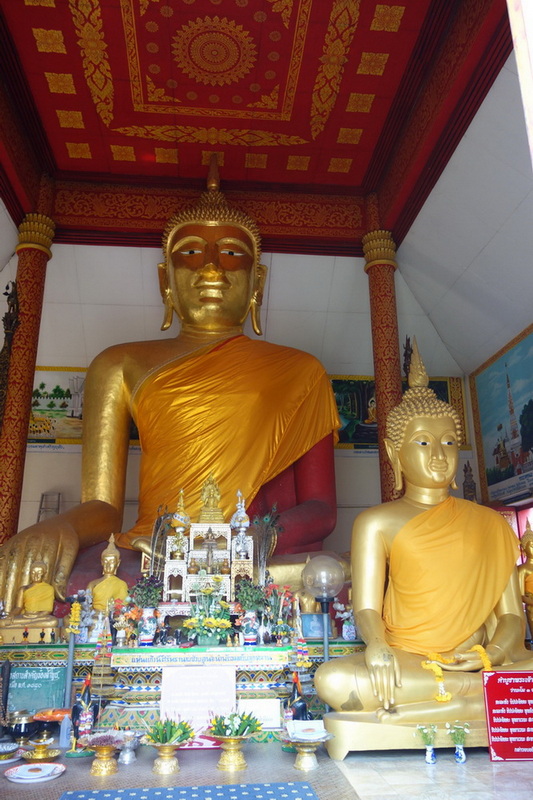
Wat Phra That Hariphunchai is the principal religious landmark of Mueang Lamphun District, Lamphun, and one of the most important destinations for travelers interested in the cultural history of northern Thailand. The temple is closely associated with the ancient Hariphunchai tradition, a historic kingdom whose legacy remains visible in the province’s religious art, monuments, and local identity. Its central chedi, devotional buildings, and continuing role as a place of worship give the complex significance beyond its appearance as a photogenic monument. The site is known by several forms, including Phra That Hariphunchai Temple, Phrathat Hariphunchai, Wat Phrathat Hariphunchai, and Wat Phra That Haripunchai Woramahawihan. Some visitors also use the shorter names Hariphunchai Temple and Wat Hariphunchai. For anyone researching Must Visit Temples In Northern Thailand, this is a particularly valuable stop because it connects living Buddhist practice with the deep historical character of Lamphun Province.
A Religious Landmark Shaped by Hariphunchai History
The importance of Wat Phra That Hariphunchai begins with its relationship to Hariphunchai, an early polity that developed in the area now known as Lamphun. The name Hariphunchai is therefore more than a temple label. It points to a regional historical tradition that has influenced architecture, religious memory, and the way the province presents its past. The temple stands as one of the clearest surviving settings in which that history remains connected to an active religious institution.
Thai Buddhist tradition gives major importance to stupas believed to enshrine sacred relics. Phra That Hariphunchai is revered in this context, and the chedi forms the spiritual focus of the temple compound. Its importance is not based solely on age or visual scale. The monument continues to carry religious meaning for people who come to make merit, worship, or participate in the wider life of the temple.
The formal name Wat Phra That Haripunchai Woramahawihan indicates the high status associated with the institution. Such a designation places the temple within Thailand’s recognized Buddhist administrative and cultural framework. For visitors, this helps explain why the site feels both monumental and closely integrated into everyday religious life. It is a historic attraction, but it is also a functioning place of faith.
The Chedi and the Temple’s Architectural Character
The most recognizable feature of Phrathat Hariphunchai is its principal stupa, whose gilded appearance gives the compound a strong visual identity. The structure draws the eye from across the grounds, yet the wider architectural setting is equally important. Viharns, smaller shrines, boundary elements, and supporting buildings create the institutional environment in which the main monument is understood.
A stupa in a Buddhist temple is not simply a tower or decorative centerpiece. Its form can represent the presence of sacred history and provide a focus for worship. At Phra That Hariphunchai Temple, the central monument is therefore best understood together with the buildings and ritual spaces around it. The arrangement expresses hierarchy: the principal chedi has special prominence, while the surrounding structures support prayer, ceremonies, teaching, and communal use.
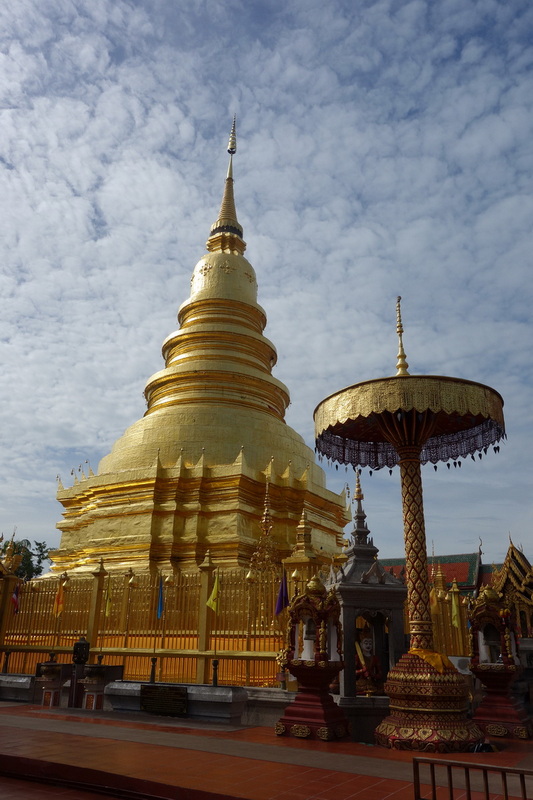
The temple’s decorative details reward a patient visit. Roof lines, finials, carved surfaces, painted areas, and layered forms belong to different aspects of northern Thai religious architecture, even when their exact dates or influences are not immediately apparent. Rather than treating every feature as a single-period design, it is more accurate to recognize that important temples often develop over time through repair, patronage, and additions. That accumulated character is part of Wat Hariphunchai’s heritage.
A Living Buddhist Institution
Wat Phrathat Hariphunchai should not be approached only as an archaeological remnant. Monks, local worshippers, families, and visitors share the compound for different purposes, and religious activity remains central to its identity. The presence of prayer, offerings, merit-making, and ceremonial use gives the site a continuity that a museum display cannot reproduce.
This continuing function also affects how the architecture should be interpreted. A hall may be admired for its ornament, but it may also be used for worship. An image or shrine may attract a visitor’s curiosity while holding profound meaning for devotees. The respectful response is to allow religious activity to take priority, keep an appropriate distance, and avoid treating sacred objects as props for photography.
Clothing that covers the shoulders and knees is a considerate choice, especially when entering worship areas. Visitors should speak quietly, follow any locally indicated direction of movement, and remove footwear where requested. Photography should never interrupt prayer or ceremonies. These simple courtesies are not merely rules of etiquette; they acknowledge that Wat Phra That Hariphunchai is a living temple whose purpose extends beyond tourism.
Why the Temple Matters in Lamphun Province
Lamphun Province has a distinctive cultural position in northern Thailand because its identity is strongly tied to the memory of Hariphunchai. Religious monuments provide an especially visible link between that past and the present. In this setting, the temple functions as a cultural anchor: it gathers historical narratives, Buddhist devotion, artistic traditions, and local community life in one place.
The temple also demonstrates how heritage can remain relevant without being separated from ordinary use. Its value does not depend on presenting the past as finished. Instead, historical memory is maintained through worship, festivals and ceremonies, restoration, family visits, and the repeated care given to a revered institution. Not every part of that history can be understood from architecture alone, which is why respectful attention to local practice matters.
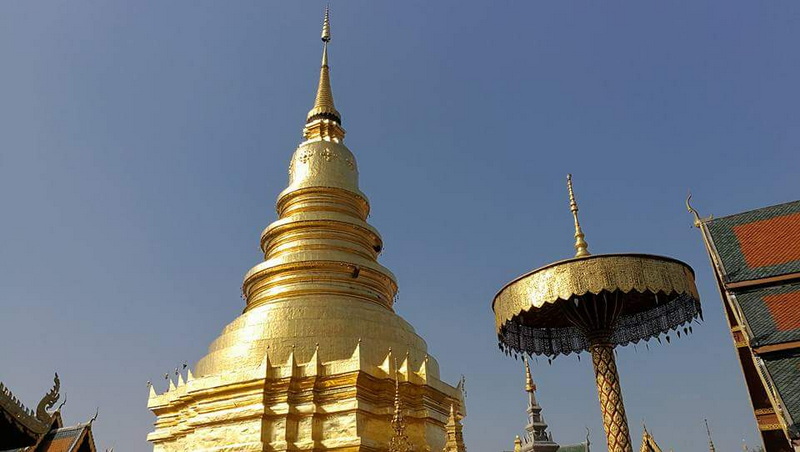
For a culture-focused traveler, the main reward is a fuller understanding of Lamphun rather than a single dramatic image. Phrathat Hariphunchai Temple presents the province as a place where religious life and regional history overlap. That context distinguishes it among Must Visit Temples In Northern Thailand and makes it especially meaningful for visitors who want to learn how a monument remains part of a community.
Practical Notes for a Considerate Visit
A visit to Wat Phra That Hariphunchai is most rewarding when enough time is allowed for both the principal chedi and the surrounding buildings. The compound contains more than one viewpoint and more than one type of heritage. A short stop can establish the temple’s visual character, while a slower visit allows the relationship between the central monument, halls, shrines, and open areas to become clearer.
Because this is an active Buddhist site, visitors should dress modestly and behave with the same care expected in any place of worship. Avoid climbing on structures, touching sacred objects without permission, or posing in ways that make religious images seem like scenery. If a ceremony is underway, remaining at the edge of the space is more appropriate than moving through it for a better photograph.
The best time for photography depends on personal preference, but the gold surfaces and architectural details can appear very different as daylight changes. Photographs should support appreciation rather than replace it. Reading a brief history of Hariphunchai before arriving can also make the buildings easier to place within their regional setting, without requiring the visitor to turn the temple into a checklist of dates and names.
Nearby Attractions
Wat Chamadevi
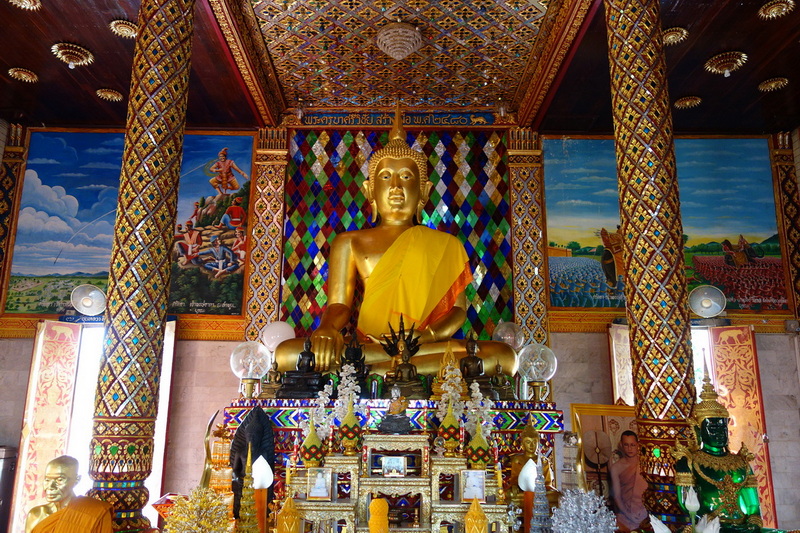
Wat Chamadevi provides a useful continuation of Lamphun’s historical and religious story. Its association with the early history of the region makes it a natural companion to Wat Phra That Hariphunchai, although the two temples should be appreciated for their own character rather than treated as interchangeable examples. Visiting both can give travelers a broader sense of how Buddhist architecture preserves local memory.
The contrast between the two sites can be especially useful for understanding the variety of forms found in Lamphun’s religious heritage. Details of structure, proportion, decoration, and setting may differ, while both remain connected to the province’s long Buddhist tradition. A visit is best approached quietly, with the same attention to worshippers and sacred spaces required at the principal temple.
Queen Cham Dhavi Monument
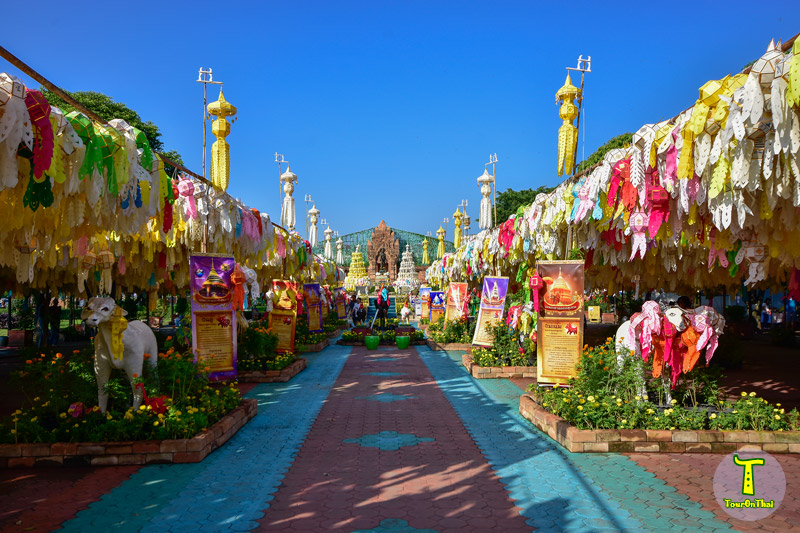
The Queen Cham Dhavi Monument adds a historical and civic dimension to a cultural visit in Lamphun. Queen Cham Dhavi is closely associated with the traditional foundation story of Hariphunchai, so the monument offers a way to encounter the region’s historical memory outside the temple compound. It is not a substitute for the religious experience of Wat Hariphunchai, but it helps explain why the Hariphunchai name remains important in local identity.
Together, the monument and Phra That Hariphunchai Temple show two related forms of remembrance. The temple carries sacred continuity through Buddhist practice, while the monument presents historical memory in a public setting. Considering both helps place the temple within the wider cultural landscape of Lamphun Province without reducing either site to a simple tourist attraction.
Why This Place Stays With You
Wat Phra That Hariphunchai brings together several layers of northern Thai heritage: the memory of Hariphunchai, the religious importance of a revered stupa, the artistry of a developed temple compound, and the continuing presence of Buddhist community life. Its value lies in this combination. Travelers may come for the gilded chedi, yet the deeper significance of the site rests in the relationship between monument, worship, and regional history. A respectful visit to Phrathat Hariphunchai leaves a clearer understanding of why Lamphun Province is culturally distinctive and why this temple remains one of the essential heritage landmarks of northern Thailand.
ไม่มีความคิดเห็น:
แสดงความคิดเห็น